
Can I Retire with $1 Million in Super?
The goal for many clients is to be able to confidently retire with their desired income, at an age that suits them, and with confidence their assets will last their lifetime.
We will look at two different client examples, Mr and Mrs North, and Mr and Mrs South.
They both have $1,000,000 in super, own their own home, no other significant assets, are 65 years old and want to retire now.
Whilst their balances and ages are the same, Mr and Mrs North are projected to be able to retire and sustain their desired lifestyle, and Mr and Mrs South are projected to be unable to sustain their desired lifestyle for life, based on the assumptions used.
What we will see is that it comes down to how much you spend and how your assets are invested.
Same starting point, different spending plans
Mr and Mrs North
Mr and Mrs North want a comfortable retirement. Nothing excessive, but enough to enjoy life. Travel from time to time, eat out occasionally, and maintain their home without stress.
Their spending goal is aligned with the ASFA Retirement Standard for a Comfortable retirement, which is currently $78,566 per year for a couple. You can view the full breakdown here:
https://www.superannuation.asn.au/consumers/retirement-standard/
At retirement they also planned to:
- Buy a new car for: $50,000
- Buy a caravan for: $40,000
They were invested as Moderate investors generating a return on super assets of 4.83% pa. The projections are based on assumed long-term returns after fees and before tax, and actual outcomes will vary.
Mr and Mrs South
Mr and Mrs South had a different view of retirement. They wanted to spend closer to $100,000 per year.
That included:
- More frequent travel
- Greater flexibility in lifestyle
At retirement they also planned to:
- Buy a new car for: $70,000
- Buy a caravan for: $90,000
They were invested as Conservative investors generating a return on super assets of 4.22% pa. The projections are based on assumed long-term returns after fees and before tax, and actual outcomes will vary.
Where the difference really comes from
On paper, both couples starting points look identical. Same age, same super balance, same starting position.
But the outcome is driven almost entirely by spending, and their investments.
Most people start with the question, “Is $1 million enough?”
But the more appropriate question is, “Is $1 million enough for the lifestyle I actually want?”
How the Age Pension fits in
Another factor that becomes very important over time is the Age Pension.
For both of these couples, starting with $1 million and no other major assets, they will begin retirement largely self-funded with the Age Pension being initially relatively low.
Over time, as their assets reduce, they are expected to become eligible for higher level of the Age Pension. That income then starts to play a meaningful role.
For many retirees, the Age Pension can provide a valuable source of income later in retirement, subject to eligibility rules and means testing.
It is vital to accurately account for the Age Pension when considering your retirement prospects.
Mr and Mrs North – Comfortable lifestyle
For Mr and Mrs North, their spending is moderate and broadly sits within what their capital, combined with investment earnings and future Age Pension support, is projected to sustain, (see chart below).
As time goes on, and as their super gradually reduces, their Age Pension entitlement tends to increase (see chart below). This helps offset some of the pressure on their portfolio.
What this means in practice is that their income is supported by a combination of:
- Investment earnings
- Controlled drawdowns
- Increasing Age Pension support over time
In many situations like this, with a disciplined plan, $1 million can be sufficient.
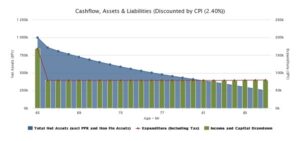
The above chart shows the projected net assets (excluding home and non-financial assets, and income and capital drawn up to Mr North’s age 87. Blue represents that assets, green the capital draw down and income, and the red line represents their expenditure needs.
The projection indicates that Mr and Mrs North may be able to maintain their desired retirement lifestyle while retaining investment assets to age 87.
It is discounted by CPI to show the values in todays dollars.
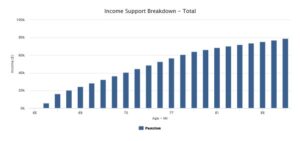
The above chart shows the projected Age Pension entitlements up to Mr North’s age 87.
Mr and Mrs South: Higher spending
For Mr and Mrs South, the higher spending for their lifestyle, higher costs for their car and caravan, and their lower exposure to growth assets, places pressure on the portfolio much earlier and leads to its depletion faster than they would like.
The higher the spending:
- The faster capital is used
- The less time investments have to compound
- The greater the risk of running out of money before your life expectancy
This does not mean their desired retirement is not possible, it just means they have options to make changes.
That might include:
- Working a few extra years
- Adjusting spending expectations
- Introducing part-time income in early retirement
- Reviewing how assets are structured and invested
- Purchasing a more modest car and caravan
Without those adjustments, $1 million is unlikely to comfortably sustain that level of lifestyle over the long term.
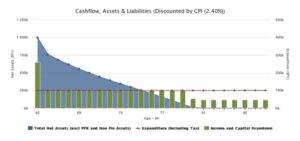
The above chart shows the projected net assets (excluding home and non-financial assets, and income and capital drawn up to Mr South’s age 87.
It shows that it is projected that Mr and Mrs South are expected to run out of investments assets at Mr South’s age 80. After this time they will be required to fund their lifestyle income needs from the Age Pension alone, which is significantly less than their desired lifestyle income.
It is discounted by CPI to show the values in today’s dollars.
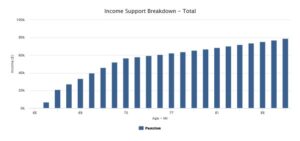
The above chart shows the projected Age Pension entitlements up to Mr South’s age 87. These entitlements do increase faster than Mr and Mrs North’s, due to their lower assets for means testing.
What really matters
After doing this for a long time, one thing becomes very clear.
It is not just the size of the balance that determines the outcome. It is how well three things align:
- The lifestyle you want
- The structure of your investments and their expected returns
- How and when income is drawn
Small changes in these areas can have a meaningful impact over time.
Where advice and modelling becomes critical
This is where planning really adds value.
Two people can look identical on paper, but once you properly model:
- Their actual spending
- Their retirement timing
- Their eligibility for the Age Pension
- And how their assets are projected to return over time
The picture becomes much clearer.
More importantly, clients move from uncertainty to confidence. They understand what is achievable and what adjustments, if any, need to be made.
Final thoughts
So, can you retire with $1 million?
The answer depends less on the size of your balance and more on the lifestyle you want to fund, how your money is invested, and how efficiently your retirement income is structured. For some retirees, $1 million may be more than enough. For others, it may not be sufficient to sustain their desired lifestyle.
For most people, the real benefit comes from understanding their position properly, rather than guessing. That clarity allows you to make better decisions and approach retirement with confidence.
If you would like to know what your retirement looks like, please reach out to me for an initial complimentary phone consultation.
Assumptions:
- Both couples establish account-based pensions at retirement
- Living expenses are indexed with CPI of 2.40% pa
- Age Pension is based in current legislation as of 16 July, 2026
- Long-term investment returns are assumed to be 4.83% p.a. for the Moderate portfolio and 4.22% p.a. for the Conservative portfolio
- Home contents value: $10,000
- Car and van values as per purchase price as above
- Projections are to the longest life expectancy
Projections are illustrative only and are not predictions or guarantees of future outcomes.
The examples above are illustrative only and are based on a range of assumptions regarding investment returns, inflation, spending patterns, Age Pension eligibility and life expectancy. Actual outcomes will differ
General Advice Warning: The information in this article and the links has been prepared for general information purposes only and does not take into account your personal objectives, financial situation or needs. It is not intended to provide commercial, financial, investment, accounting, tax or legal advice. You should, before you make any decision regarding any information, strategies, or products mentioned in this article, consult a professional financial advisor to consider whether it is suitable and appropriate for you and your personal needs and circumstances. Before making a decision to acquire a financial product, you should obtain and read the Product Disclosure Statement (PDS) relating to that product, together with the Target Market Determination (TMD).